

„Do you have any experience?” This is probably one of the most common questions graduates face during their first job interview. The paradox is that most employers seek candidates who already have a portfolio, practical experience, and demonstrable results, yet very few opportunities actually allow students to gain these before graduating.
In fields such as journalism, international relations, or European affairs, practical experience has become almost as important as a university degree. A well-written CV is no longer enough unless it is supported by published articles, tangible projects, or collaborations with recognized organizations and media outlets. As a result, an increasing number of students are looking for programs that provide access to editorial newsrooms, mentorship, and genuine publishing opportunities.
Building a portfolio before graduation can make the difference between a candidate who is just starting out and one who has already demonstrated the ability to work in a professional environment. For students interested in journalism and European affairs, editorial experience goes beyond practicing writing – it also means learning how to research complex topics, collaborate with editors, meet professional standards, and publish for an international audience.
At a time when the European Union is simultaneously facing challenges related to security, enlargement, disinformation, and geopolitical changes in its eastern neighborhood, there is a growing need for a new generation of journalists and analysts capable of explaining these developments in a rigorous yet accessible way. Topics such as the EU accession process of partner countries, security in the Black Sea region, democratic resilience, countering disinformation, European policymaking, EU–Eastern Partnership relations, and the impact of Russia’s war against Ukraine on the region are increasingly prominent on the public agenda and require well-researched, evidence-based analysis.
Developing these skills does not begin after employment—it starts during university through practical experiences and international collaboration. Programs that bring together participants from multiple countries offer an additional advantage. Working in an international team fosters collaboration skills, a broader understanding of regional perspectives, and the ability to approach issues beyond national boundaries. At the same time, mentorship from experienced journalists accelerates the learning process and helps participants develop their own editorial voice.
In an increasingly competitive job market, international experience often carries greater weight than experience gained solely at the national level. Collaborating with editors from international media organizations, publishing in English, and working in a cross-border newsroom demonstrate not only journalistic competence but also the ability to thrive in a multicultural environment, understand international editorial standards, and cover topics of European relevance. For employers in European institutions, international organizations, think tanks, or leading media outlets, these experiences are an important indicator of adaptability and professionalism.
International Experience Matters More Than National Experience
Another important aspect is visibility. Publishing articles in an international publication or platform is more than a personal achievement—it serves as a professional calling card. For employers in the media sector, think tanks, or European institutions, a portfolio that demonstrates editorial experience and the ability to analyze European affairs can carry significant weight during the recruitment process.
In recent years, career paths have become increasingly non-linear. Many professionals now working in journalism, research, international organizations, or European institutions began their careers through volunteer projects, mentorship programs, or editorial initiatives while still at university. These experiences provided them not only with technical skills but also with professional networks, confidence, and access to international communities.
For students, investing in such a program can have long-term benefits. A published article, constructive feedback from an experienced editor, or collaboration with peers from other countries can become the first steps toward a career in journalism, communications, European affairs, or public policy. In a competitive job market, the difference is often made by what you have accomplished before graduation—not just by the degree you have earned.
Initiatives that combine mentorship, international publication opportunities, and cross-border collaboration help bridge the gap between higher education and labor market expectations. They enable young people to transition more smoothly from students to professionals while contributing to the development of a new generation of journalists and analysts capable of explaining the challenges facing Europe and the Black Sea region from an informed and responsible perspective.
An Opportunity to Gain Editorial Experience in an International Newsroom
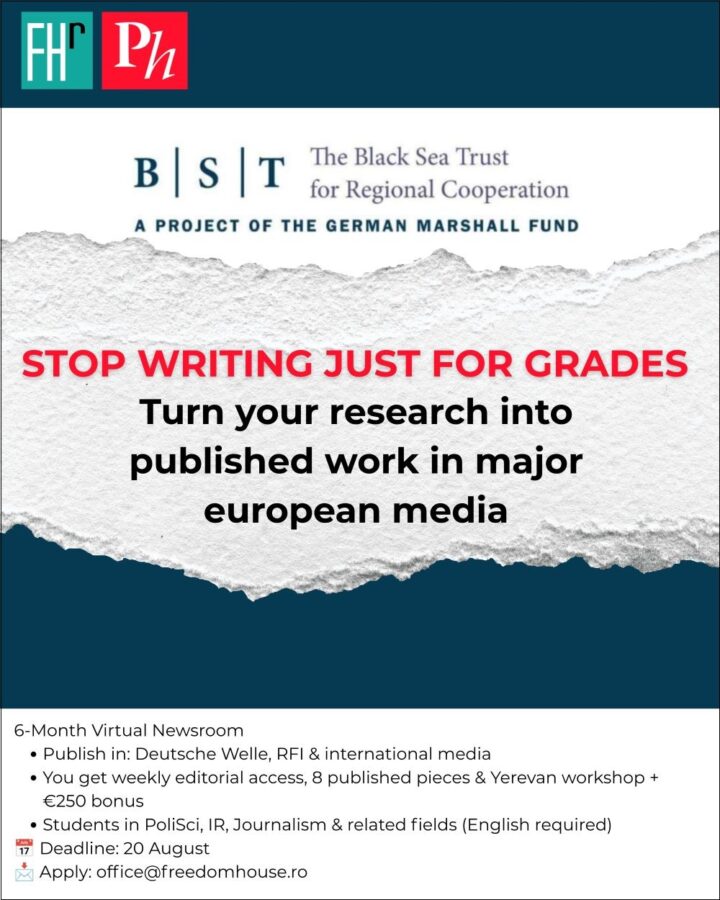
The Black Sea Desk: Writing the Region into Europe is built on the belief that a new generation of journalists and analysts can contribute to a deeper understanding of the Black Sea region and the European integration process. The program brings together participants from Romania, Georgia, and Armenia in a virtual newsroom where they will produce articles on topics including European integration, regional security, Black Sea geopolitics, countering disinformation, and developments in the European Union’s eastern neighborhood.
If you are a student or recent graduate studying journalism, international relations, political science, or a related field, you will have the opportunity to work alongside experienced editors and mentors, publish articles in English through international media partners such as Deutsche Welle (DW) and Radio France Internationale (RFI), and collaborate with peers from across the region.
The program includes weekly editorial sessions, the production of both individual and collaborative articles, and concludes with an editorial workshop in Yerevan. Participants who successfully complete the program will also receive a €250 completion stipend.
Applications are open until 20 August 2026. If you would like to build an international editorial portfolio while still at university and publish analyses relevant to the European agenda, you can find more information and the application form here: