
“E-mpact – Together for Participatory and Active Mobilisation Against Disinformation” was an initiative coordinated by Freedom House Romania, in partnership with the Center for Democracy and Human Rights of Montenegro (CEDEM) and Transparency International Moldova. It aimed to strengthen media literacy and resilience against disinformation in Romania, the Republic of Moldova, and Montenegro. The project was aimed primarily at university students, teachers, and high school students from all three countries, particularly those from disadvantaged backgrounds, encouraging them to become more critical, better-informed, and more actively engaged citizens.
Through training sessions, such as Training of Trainers (ToT) programmes, interactive workshops, and a creative meme competition, participants had the opportunity to explore the challenges posed by disinformation and develop new ways of addressing them through creativity and critical thinking. The project also promoted democratic resilience, civic participation, and Francophone values, bringing together diverse voices and perspectives in an inclusive, multilingual, and transnational environment.
Among the participants who stood out was Delila Agovic who won Third Prize in the creative competition. Through her work, Delila offered an original perspective on the phenomenon of disinformation, using creativity to convey an important message about the need to question, verify, and critically analyse the information we encounter every day.
Delila is 17 years old and a high school student with a passion for reading, photography, and writing. In her free time, she enjoys getting lost in the pages of books and capturing moments with her camera. Her love of writing has also led to an important personal achievement: in March, she is set to publish her own book.
Her participation in the “E-mpact” project gave her the opportunity to work closely with her classmates and transform a creative idea into a team effort. Together, they explored the phenomenon of disinformation, aiming not only to capture people’s attention but also to encourage them to question the information they encounter. Through their project, they wanted to observe how people would react and whether they would be willing to believe everything they saw or read, particularly online.
In the interview below, Delila talks about the inspiration behind her award-winning creation, reflects on her experience throughout the project, and discusses what participating in the competition and winning Third Prize meant to her. We also discover her perspective on disinformation and the role young people can play in building a better-informed and more resilient society.
PRESShub: Tell us a little about yourself. We would like to get to know you better. What is the story behind your project?
Delila Agovic: My name is Delila, I am 17 years old, and I am a student at Gimnazija “30 septembar”. In my free time, I really enjoy reading and taking photographs with my camera. On top of that, I also love writing, and in March I will be publishing my own book.
As for this project, it was an amazing experience to work alongside my classmates because we motivated one another, and the entire process was a team effort. The idea behind the project was to explore the world of disinformation. Our goal was to attract attention, but also to create a certain sense of confusion. We wanted to see how people would react and whether they would believe everything they saw or read.
PRESShub: How did you come up with the idea of creating a video that essentially performs or re-enacts the news presented on television? Can you tell us more about how the media operates and how false news and information spread in Montenegro?
Delila Agovic: I believe that media literacy should have a much stronger presence in our education system. In Montenegro, there is some form of media literacy education, but it is mainly introduced around the sixth grade, and I do not think that is enough.
I believe that media literacy should also be taught in high school, when students are older and better prepared to think critically and understand the information they are exposed to. This is especially important today because technology has developed very rapidly, and social media has become such an important part of teenagers’ everyday lives.
A few years ago, platforms such as Instagram were not part of our daily lives in the way they are today. Now, young people constantly encounter information through social media, which makes it even more important for them to understand how the media works, how information can be manipulated, and how to distinguish between trustworthy information and disinformation.
That is why I believe we need stronger and more consistent media literacy education, not only in Montenegro but everywhere. Young people should be given the tools they need to navigate the online world critically and responsibly.
PRESShub: Tell me more about your interest in media and disinformation. How did you find out about this competition?
Delila Agovic: After finishing high school, I would like to continue my studies in the field of media because I am very interested in journalism and would like to become a journalist. I know that journalism is not necessarily the highest-paying career, but I believe it is a profession that requires genuine passion. For me, it is a field where you can constantly learn, grow, and have an impact on the people around you.
Through this competition, I became particularly interested in political journalism and in the way information is presented in the media. We see information everywhere, but very often it is difficult to know whether it is accurate because we do not always have reliable sources available to verify it.
That is why I believe that projects, workshops, and especially digital tools that help people verify information are so important. I really like the idea of creating platforms through which users can access reliable sources and check whether a piece of information is true or misleading. I believe that such tools can make a real difference, especially for young people who face an overwhelming amount of information online every day.
Delila’s story is, ultimately, about the courage to believe in an idea and the determination to turn that belief into action. At a time when disinformation is increasingly influencing the way we understand and perceive the world around us, critical thinking, personal responsibility, and active engagement have become more important than ever.
Through the “E-mpact” project, participants had the opportunity to demonstrate that change can begin with a single person, a single idea, and the desire to do things differently. For Delila, winning this award represents not only recognition of her hard work and creativity, but also encouragement to keep moving forward and continue making a difference.
Believe in yourself. Believe in your ideas, in your ability to make a difference, and in the power of your actions to bring about meaningful change. Sometimes, change begins with nothing more than the courage to believe that you can make it happen.
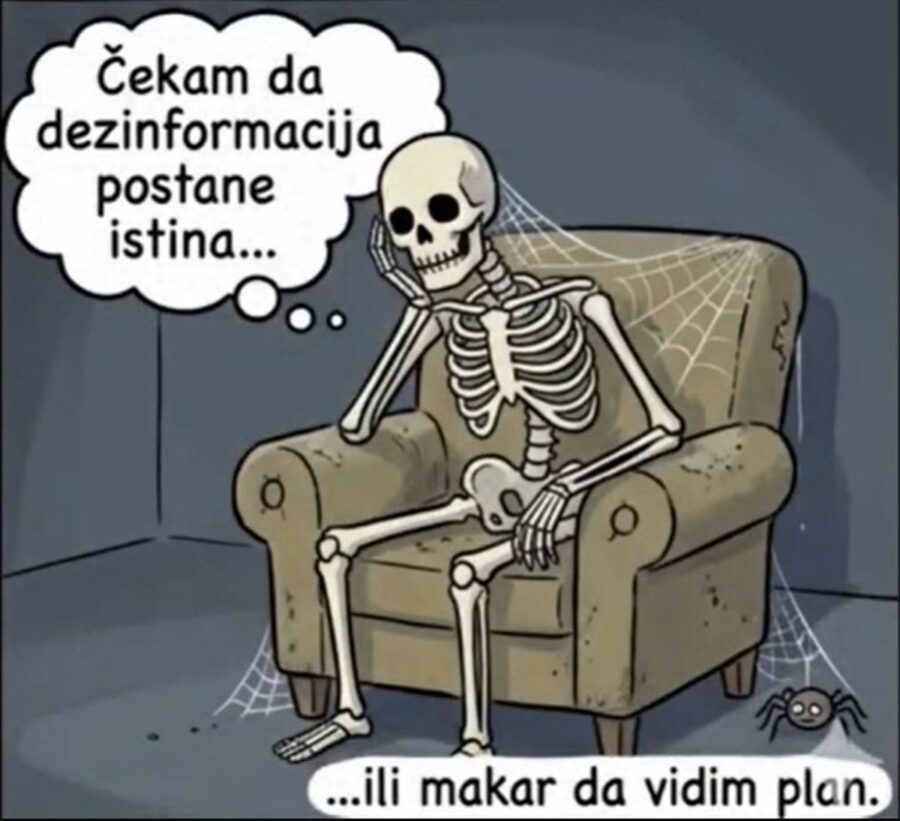
“Waiting for disinformation to become truth… or at least to see the plan.”