

E-mpact – Together for a Participatory and Active Mobilization Against Disinformation was a project coordinated by Freedom House Romania, in partnership with the Center for Democracy and Human Rights in Montenegro (CEDEM) and Transparency International Moldova. The project aimed to strengthen media literacy skills and the ability to combat disinformation in Romania, the Republic of Moldova, and Montenegro. It targeted students, teachers, and high school pupils from all three countries, particularly those from disadvantaged backgrounds, and sought to develop critical thinking, promote democratic resilience, and encourage young people’s civic engagement.
Throughout the project, Training of Trainers (ToT) sessions, interactive workshops, and a creative meme competition were organized, giving participants the opportunity to explore the topic of disinformation in an accessible and creative way. At the same time, the initiative promoted Francophone values and encouraged an inclusive, multilingual, and transnational approach, with the goal of creating a lasting impact through freely accessible educational tools and a regional media campaign.
As part of this initiative, a creative competition was also held, in which Nicolas Cârstoiu won First Prize for his original contribution to promoting media literacy and combating disinformation.
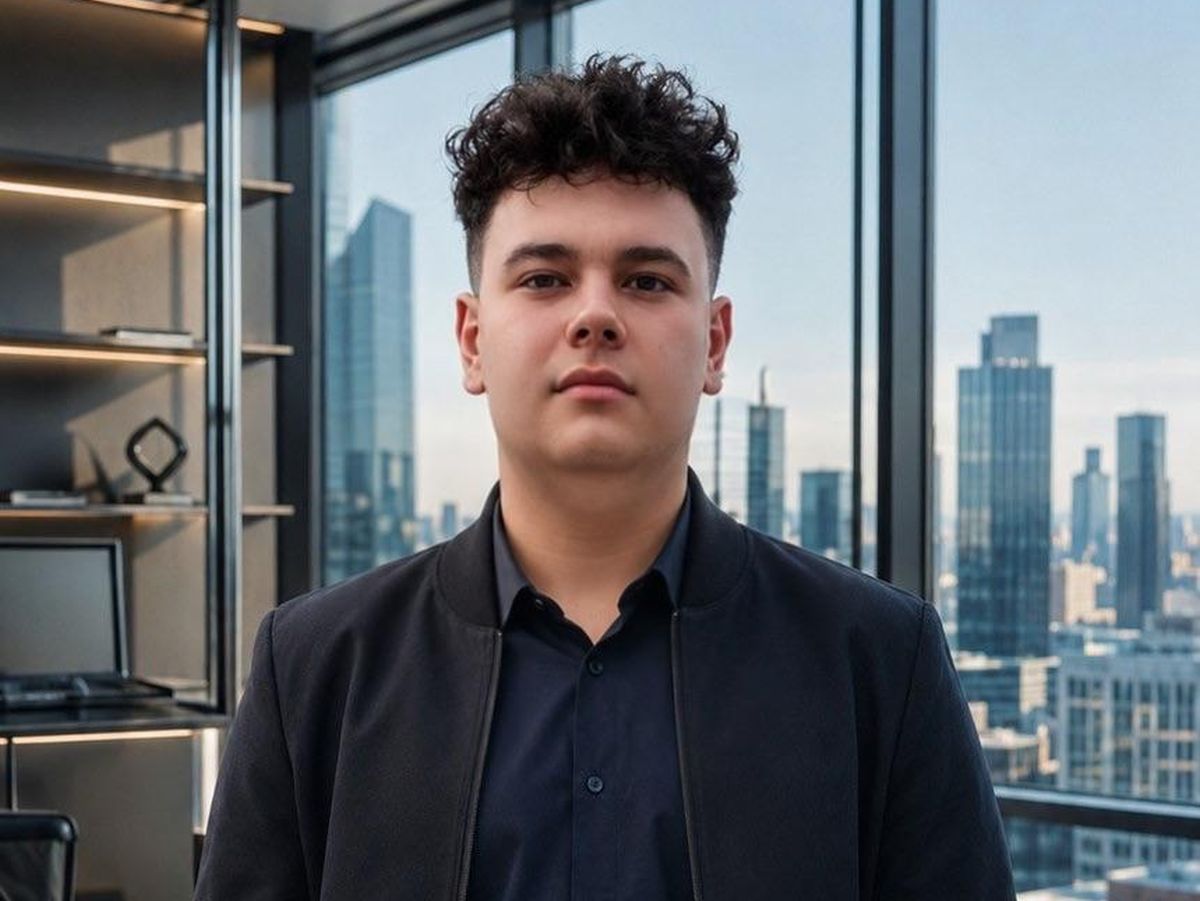
Nicholas Cârstoiu is 17 years old and an 11th-grade student in the Mathematics and Computer Science program at the Romanian-Finnish High School. He is a curious person who is always eager to discover new things, and this openness is also reflected in his involvement in volunteer projects, an activity he has been engaged in for approximately four years. Outside school and the projects he takes part in, Nicholas is passionate about basketball and spends part of his time online, where he enjoys learning, exploring, and constantly discovering new information and perspectives.
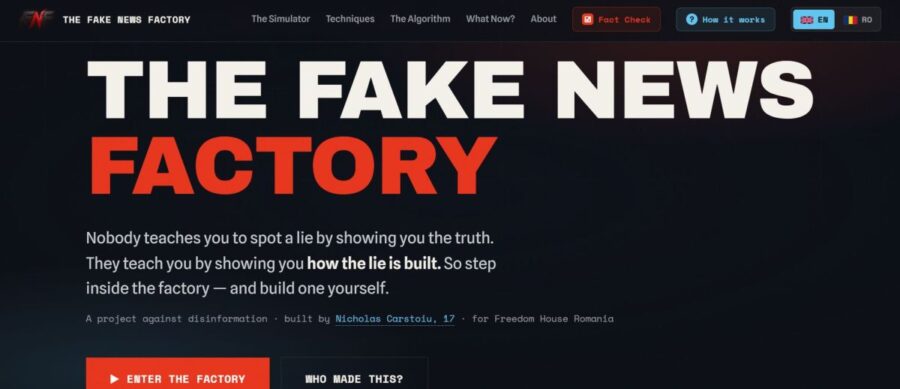
Nicholas won the competition organized by E-mpact by creating a platform that is easy to understand and encourages users to learn how fake news is created, how misleading information can be detected, and how it can be challenged, in essence, how to understand and combat disinformation. In the interview below, Nicholas tells us about his experience, the idea behind his winning creation, and the lessons he learned from participating in the project.
PRESShub: So, is basketball your main passion
Nicholas Cârstoiu: It used to be, but now I’m trying to prioritize activities that contribute to my future. Over time, I’ve developed a passion for cybersecurity.
PRESShub: And where did this passion for cybersecurity come from?
Nicholas Cârstoiu: My father played an important role. Ever since I was little, he introduced me to this field. I learned a great deal from him. He taught me what to look for and what to avoid on the internet. He supported me and helped me understand what to do when different people contact me or send me suspicious links, and, most importantly, how to protect myself from such dangers online.
PRESShub: We know that you are a student in the Mathematics and Computer Science program at the Romanian-Finnish High School and that you are actively involved in school life, taking part in various activities and projects. How would you describe this experience, and what does being involved in the school community mean to you?
Nicholas Cârstoiu: I have been a student at the Romanian-Finnish High School since preparatory grade, and I care deeply about this institution, especially because of the unique way people are treated here. The teachers are very understanding, and I have a very good relationship with my classmates.
When it comes to volunteering, I am part of the school’s volunteer team and try to get involved as much as possible in the school’s initiatives. In addition, for about a year now, I am an assistant basketball coach for middle and high school students., an experience that I enjoy very much and through which I feel I can contribute to the school community.
Beyond the activities I take part in at school, I have been a member of the the Romanian Children’s Board, supported by UNICEF, and I am also a member of the Children’s Consultative Council of the Bucharest City Hall. All these experiences have given me the opportunity to get involved, learn new things, and actively contribute to the communities I am part of.
PRESShub: Tell us a little more about your activities.
Nicholas Cârstoiu: Within the Romanian Children’s Board, the activity is much more intense. We try to travel as often as possible to different parts of the country, where we take part in initiatives aimed at helping children in difficult situations. We also have the opportunity to give speeches alongside important figures, including at the Senate, and to participate in interviews, both in the written press and on the radio.
It is a very active experience, especially because we are a group of around 30 children from all over the country and we are involved in numerous projects and initiatives. As for the Bucharest Children’s Council, unfortunately, the activity has not been as intense lately.
PRESShub: Moving on to the competition, tell us a little about how you came to participate. We know that you created a platform that impressed us greatly. How did the idea behind it emerge, how did you develop it, and, most importantly, how does it work?
Nicholas Cârstoiu: I entered this competition thanks to my teacher, who strongly encouraged me to participate because she knows that this is one of the fields I am passionate about. I started working on the project during a social sciences class, where our topic was disinformation in the online environment and how we can help people better understand and manage the information they encounter.
The entire project, from the initial idea to the website and the interactive laboratory, started from a very simple question: why can’t we teach today’s teenagers about disinformation and online manipulation in the same way we learn anything else, through experience?
Starting from this question, I created an interactive experience in the form of a website where any user can create their own piece of “fake news.” Users can experiment with different manipulation techniques by choosing certain words and emotions in order to understand how people can be influenced and how easily a message designed to persuade them can be constructed.
PRESShub: And what inspired you to create this website?
Nicholas Cârstoiu: At the time, I didn’t yet have the level of knowledge needed to write every line of code for the website entirely on my own, from scratch. However, I had a great deal of creativity and a very clear idea of what I wanted to build. So, my father and I decided to work together on the technical side of the project.
I tried to contribute as much as I could, based on the level of knowledge I had as an 11th-grade student, while he mainly helped me with the programming and taught me many things along the way. I focused more on the interface, making sure that the website would be as intuitive, accessible, and easy to understand as possible.
I also worked on the way the information is presented and on the idea of a verification tool through which any user can enter a text, a post, or a headline, and the website provides a risk score from 0 to 100, indicating how manipulative that content might be. I wanted the entire project to be not only informative, but also as interactive and user-friendly as possible.
PRESShub: If you could send a message to young people, especially those who are confronted with disinformation online, what would it be?
Nicholas Cârstoiu: My message to young people is that, many times, we learn better through experience than through theory alone. I believe it is important to experience things firsthand because that is how we can truly understand both the positive aspects and the less positive ones.
At the same time, I would also like to send a message to adults. I was not fully supported by some people who did not believe in my idea. I think that sometimes it is easier for an adult to forbid something they do not understand or are not sure is beneficial or safe for a child.
That is precisely why I believe it is important for adults to experiment as well and to try to understand the world we live in. They should go online, explore platforms such as the one I created, and see what children and teenagers actually do every day and why they spend so much time in the online environment. I believe that, before forbidding or judging something, it is important to understand it.
Nicholas’s story is, ultimately, about having the courage to believe in an idea and turning that belief into action. In a context where disinformation increasingly affects the way we understand the world around us, engagement, critical thinking, and each individual’s sense of responsibility become essential.
Through the “E-mpact” project, participants had the opportunity to demonstrate that change can begin with a single person, an idea, and the desire to do things differently. Nicholas’s award is not only a recognition of his work, but also an encouragement to continue moving forward.