

Your First Job Starts with a Simple Question: „Do You Have Any Experience?”
For many university students, one challenge defines their academic years: how do you get your first job when most employers require prior experience? In fields such as journalism, international relations, European affairs, and public policy, competition is becoming increasingly intense, and a university degree alone is no longer enough to stand out. More often than not, the hiring process begins with a simple question: „What have you done so far?”
The answer is no longer limited to attending lectures or achieving strong academic results. Employers want tangible proof that a candidate can research a topic, collaborate with others, meet deadlines, and produce content that is relevant to a real audience. In other words, they are looking for a portfolio.
Your Portfolio Is the New CV
For aspiring journalists, a portfolio means published articles. For those pursuing careers in European institutions, international organizations, or think tanks, it may include policy papers, analytical articles, or research reports. In every case, however, practical experience is what transforms academic knowledge into professional skills.
This is why programs offering genuine editorial experience are increasingly replacing the traditional internship model. Unlike internships where participants often play only a limited role, these initiatives involve them directly in researching, writing, editing, and publishing content, giving them responsibilities similar to those found in a professional newsroom.
Why International Experience Matters
International experience adds another dimension to professional development. Collaborating with participants from different countries, writing in English, and publishing for a European audience demonstrate the ability to work in a multicultural environment and cover issues of regional significance.
Participants also gain experience writing about topics such as European integration, Black Sea regional security, European Union foreign policy, democratic resilience, countering disinformation, and EU relations with the Eastern Partnership countries. These issues are increasingly prominent on the European agenda and are of growing interest to media organizations, European institutions, and international organizations alike.
For many employers, experience gained through an international project represents a stronger competitive advantage than an internship completed solely within a national context.
More Than Just an Internship
A well-designed program provides much more than work experience. It also offers mentorship, constructive feedback, and access to a professional network. Participants learn how to structure an article, verify information, work with editors, and meet the standards of international journalism.
At the same time, collaborating with peers from different countries strengthens communication, teamwork, and cross-cultural collaboration skills—competencies that are highly valued not only in journalism but also in European institutions, think tanks, international organizations, and the public sector.
When Experience Comes with Real Benefits
For many students, participating in an intensive program also involves financial considerations. That is why initiatives that provide tangible support help reduce barriers to participation and make these opportunities accessible to a wider range of young people.
In addition to publishing opportunities in international media and mentorship from experienced editors, such programs may include participation in international events, networking opportunities, and even completion bonuses. These benefits not only provide financial support but also recognize participants’ commitment and the work they invest throughout the program.
An Investment in Your Future Career
Experiences like these help participants develop transferable skills, including research, analytical thinking, writing, critical thinking, English-language communication, and collaboration in multicultural environments. These are competencies sought after not only by news organizations but also by public administrations, European institutions, international organizations, and non-governmental organizations.
In an increasingly competitive job market, the difference is often made by what you have accomplished before graduation. An international portfolio, developed in collaboration with experienced editors and experts, can become one of your strongest assets at the beginning of your career.
An Opportunity for Students Interested in Journalism and European Affairs
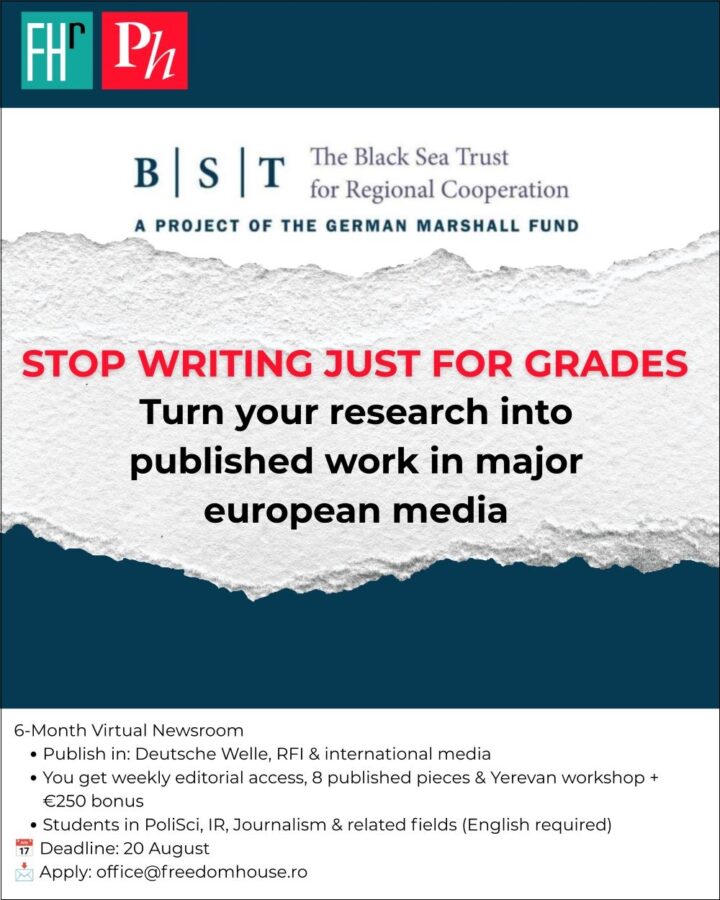
The Black Sea Desk: Writing the Region into Europe is built on the belief that a new generation of journalists and analysts can contribute to a deeper understanding of the Black Sea region and the European integration process. The program brings together participants from Romania, Georgia, and Armenia in a virtual newsroom where they will produce articles on topics including European integration, regional security, Black Sea geopolitics, countering disinformation, and developments in the European Union’s eastern neighborhood.
If you are a student or recent graduate studying journalism, international relations, political science, or a related field, you will have the opportunity to work alongside experienced editors and mentors, publish articles in English through international media partners such as Deutsche Welle (DW) and Radio France Internationale (RFI), and collaborate with peers from across the region.
The program includes weekly editorial sessions, the production of both individual and collaborative articles, and concludes with an editorial workshop in Yerevan. Participants who successfully complete the program will also receive a €250 completion stipend.
Applications are open until 20 August 2026. If you would like to build an international editorial portfolio while still at university and publish analyses relevant to the European agenda, you can find more information and the application form here: